
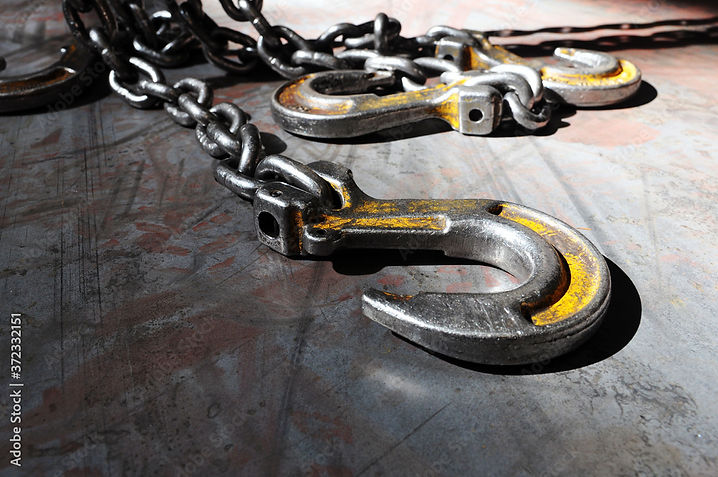


LIFTING TIE RODS
Lifting slings, also known as slings, are accessories that are placed between the lifting device and the load.
There are mainly 3 different types of lifting slings or slings:

This type of lifting sling is made of steel wire ropes with textile and/or metallic cores, fitted at the ends with terminals that allow connection to the hooks of the lifting equipment, to the loads to be lifted, or to machine components.
The terminal generally consists of an eye loop, to which accessories such as thimbles, hooks, omega shackles, etc. may sometimes be fitted. The eye loops are manufactured either by pressing lightweight aluminum alloy sleeves or by hand splicing the strands that make up the rope itself. The rope used for this type of sling can be bright steel and/or galvanized steel, and the safety utilization factor of the complete assembly at maximum load must never be less than 5.
Appropriate identification tags must always be present in compliance with CE regulations, indicating:
Serial number;
Working load limit;
Length;
Rope diameter;
Number of legs;
Manufacturer’s trademark or name.
All these characteristics must also be stated on the paper certificate that will be issued at the time of sale.
The maximum load indicated on the permanent identification tag must always be respected. In addition, it is mandatory to:
Avoid placing the ropes in contact with sharp edges that could cause cutting;
Do not lift loads while people are passing through the area where the operation is being carried out;
Do not tie knots or perform welding on the slings;
Do not bend steel wire ropes near the sleeves;
Do not carry out temporary repairs or repairs that do not comply with standards.

The harness chain is characterised by a safety or use coefficient which must never be less than 4.
It is essential to know the mass of the load to be lifted. If the weight is not specified or known, it can be determined by consulting delivery notes, manuals, drawings, etc.
If the information is not available, the weight can be calculated.
The position of the centre of gravity of the load must be identified in relation to the possible attachment points of the tie rod.
To lift the load without it tilting or swinging, the following conditions must be met:
a) For single-leg slings, the attachment point shall be located vertically above the centre of gravity.
b) for two/four-leg tie rods, the attachment points must be located on opposite sides and above the centre of gravity.
When using two-, three- and four-leg slings, the anchor points and the sling configuration shall be chosen so that the angles between the sling legs and the vertical are
within the range marked on the tie rod plate.
All tie rods with multiple arms generate a horizontal force component, which increases as the angle between the arms themselves (vertex angle) increases.
Where hooks or other fixings are threaded through a loop of chain, such as around a crate, drum or pipe, the horizontal component of the force will be much greater and consequently the angle of such legs should not exceed 60°.

Polyester webbing lifting slings provide a practical and effective solution to all problems relating to the connection between the crane hook and the load being lifted.
The advantages of choosing these slings over traditional steel wire rope or chain slings can be summarized as follows:
Maximum handling;
Good weight/lifting force ratio.
There are no internal joints or friction or abrasion phenomena;
There are no metal parts;
Maximum ease of use;
Limited elongation;
Perfect adherence to the shapes of the loads to be lifted;
Each ribbon, being colored differently depending on the pruning, is quickly identifiable for the required need;
Complete immunity to water, oils and fats.
The minimum safety factor for polyester slings is 7.
All tie rods and various lifting groups are supplied with a plate showing the manufacturer's name, the capacity, the "CE" marking and the certificate of conformity number.
It will be necessary to store the lifting slings correctly, in areas not subject to humidity and to ensure from time to time that they do not suffer damage and wear after use.
Every three months, the condition of the tie rod and all its components must be inspected and checked. If the condition is negative, it will need to be replaced.
For this purpose, MECI srl has highly qualified personnel, authorized and recognized to perform this type of service.